
Sugar; you know it’s bad for you so you do the right thing and try not to eat too many cakes, sweets, candies, and desserts. You might have stopped adding sugar to your coffee too and even made the switch to diet soda. Not that artificial sweeteners are a whole lot better than sugar but that’s another story.
All of these strategies are a good way to lower your sugar intake and yet, a large percentage of the population still consumes way too much sugar.
The problem is that, even if you cut obvious sugar from your diet, it is often hidden away in foods that you might be forgiven for thinking contain little or no sugar. Sugar is often concealed in plain sight by food manufacturers and given names that disguise the presence of sugar.
The thing is, when you see sugar on a food label, this refers solely to the presence of sucrose or table sugar. If a nutrition label says 5 grams of sugar, it means the food you are considering eating contains around one teaspoon of sucrose. However, other sugars are not listed the same way and are counted as part of the carbohydrate content despite being sugars too. Those food manufacturers are very sneaky!
So why the underhanded and intentionally deceptive labelling?
Quite simply, the food manufacturers know that many of us are on the lookout for sugar and want to try and avoid it. By hiding the sugar content in plain sight, they aren’t breaking any laws but people who are less label-savvy are duped into eating more sugar than they might otherwise want to.
Adding sugar to foods makes you want to eat more of it. That’s why sugar turns up in some pretty obscure foods that it really doesn’t belong in. Potato chips and soups are good examples, and more than 70% of processed foods are also loaded with sugar.
Sugar, in any form, is addictive. You’ll know this already if you have ever tried to give up sugar. But sugar addiction is good for food manufacturers; it means you’ll keep on spending your hard-earned money on the food they want you to buy. However, all the sugar is not only bad for your teeth and your weight but bad for your healthy too. Excess sugar consumption is inextricably linked to a host of serious medical conditions. From Alzheimer’s disease to cancer to heart disease to diabetes – sugar is the leading cause.
By being more sugar aware, you are less likely to inadvertently consume too much sugar. Make sure you not only check the nutrition label but also the ingredients list on the food you buy. Remain vigilant and be on the lookout for sugar and it’s many different names.
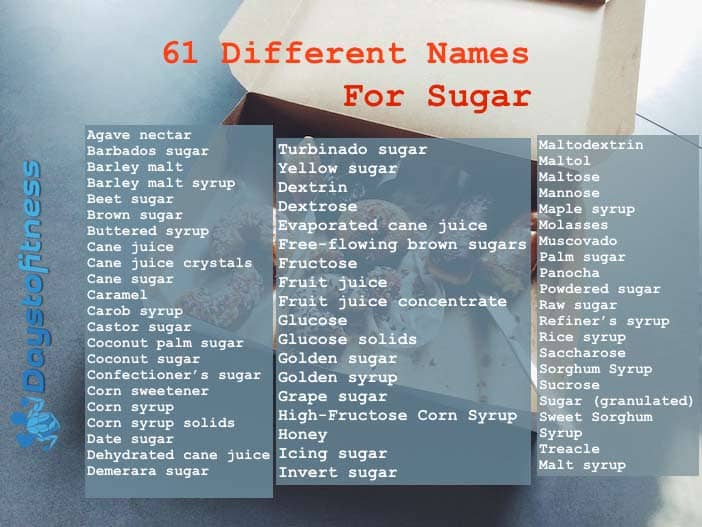
Check out the list below to discover 61 different names for sugar…
- Agave nectar
- Barbados sugar
- Barley malt
- Barley malt syrup
- Beet sugar
- Brown sugar
- Buttered syrup
- Cane juice
- Cane juice crystals
- Cane sugar
- Caramel
- Carob syrup
- Castor sugar
- Coconut palm sugar
- Coconut sugar
- Confectioner’s sugar
- Corn sweetener
- Corn syrup
- Corn syrup solids
- Date sugar
- Dehydrated cane juice
- Demerara sugar
- Dextrin
- Dextrose
- Evaporated cane juice
- Free-flowing brown sugars
- Fructose
- Fruit juice
- Fruit juice concentrate
- Glucose
- Glucose solids
- Golden sugar
- Golden syrup
- Grape sugar
- HFCS (High-Fructose Corn Syrup)
- Honey
- Icing sugar
- Invert sugar
- Malt syrup
- Maltodextrin
- Maltol
- Maltose
- Mannose
- Maple syrup
- Molasses
- Muscovado
- Palm sugar
- Panocha
- Powdered sugar
- Raw sugar
- Refiner’s syrup
- Rice syrup
- Saccharose
- Sorghum Syrup
- Sucrose
- Sugar (granulated)
- Sweet Sorghum
- Syrup
- Treacle
- Turbinado sugar
- Yellow sugar